
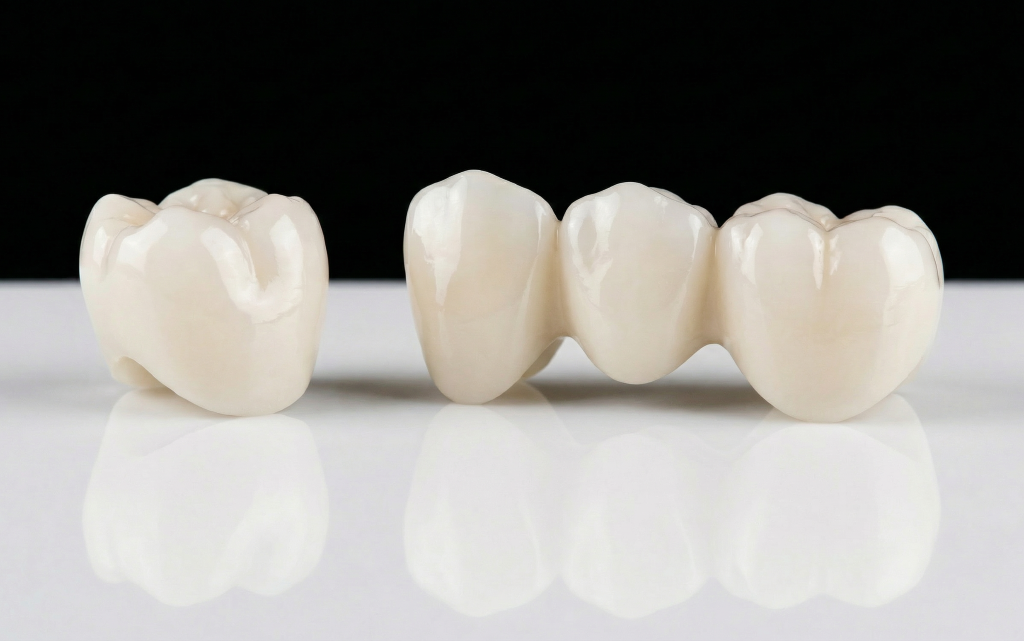
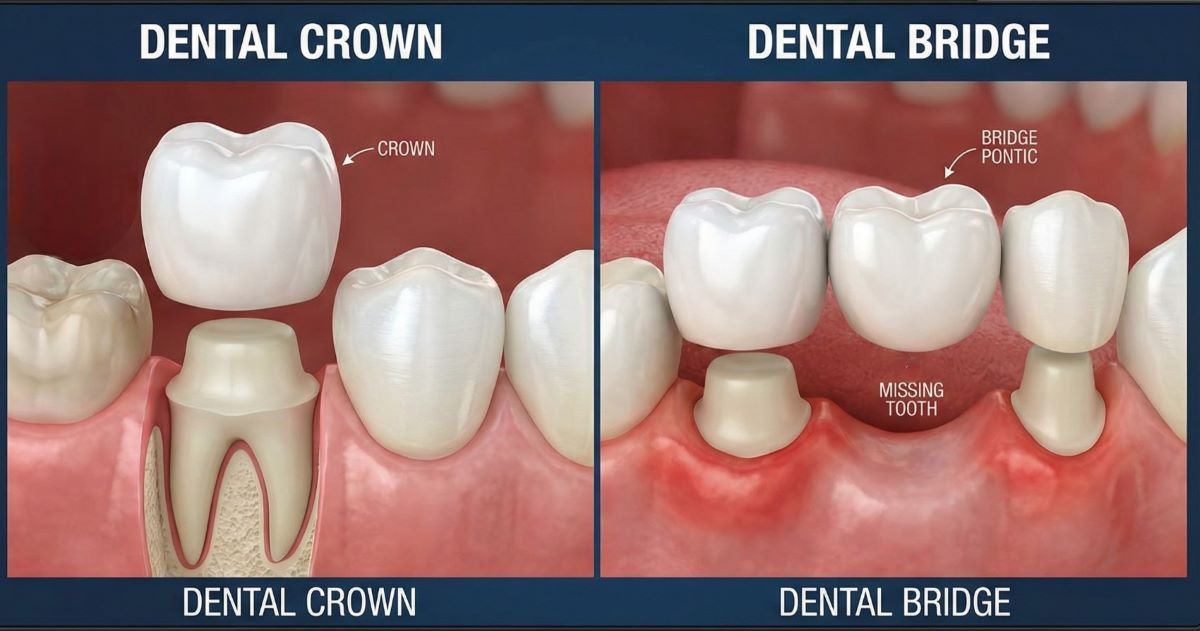
A crown restores and protects a damaged or weakened tooth. A bridge replaces one or more missing teeth using the teeth on either side for support. Crowns are often recommended after a large filling or root canal treatment, and every recommendation here follows a clinical evaluation rather than a preference.
What Crowns and Bridges Do Here
- Crowns restore and protect damaged or weakened teeth
- Bridges replace one or more missing teeth, where adjacent teeth can support the replacement
- Zirconia and porcelain-fused-to-metal crowns available
- Traditional, cantilever and Maryland bridge designs
- Material and design chosen on strength, aesthetics and bite
- Treatment recommendation based on clinical evaluation
Dental crowns and bridges solve two different problems, and mixing them up is the most common confusion patients arrive with. One saves a tooth you still have. The other fills a space where a tooth used to be.
When Is a Crown Recommended?
To restore and protect a damaged or weakened tooth. Four situations bring it up:
- After a large filling. Once enough of the tooth has been replaced with filling material, the remaining structure needs holding together.
- After root canal treatment. A root canal treatment tooth has had its inside removed and is more brittle as a result.
- Extreme wear. This is the dentist's own addition to the standard list, and it matters for anyone grinding at night.
- Old or failing fillings, where the restoration has done its work and the tooth now needs more than another filling.
That third point connects to something worth acting on: if wear is the reason a crown is needed, a night guards appliance protects the crown once it is placed. Dental crowns and bridges are only as durable as the forces acting on them.
What Types of Crowns Are Available?
Two materials, chosen deliberately rather than by default:
- Zirconia crowns, which are strong and used where bite force is the main consideration
- Porcelain-fused-to-metal crowns, a long-established option combining a metal substructure with a porcelain surface
Material and design are chosen based on strength, aesthetics and bite. Those three pull against each other, and where the tooth sits decides which wins. A back molar taking heavy load is a different problem from a tooth visible when you smile.
Patients searching for dental crowns near me sometimes ask for a material by name. The more useful conversation is about the tooth.
What Types of Bridges Are Available?
Three designs, each for a different situation:
- Traditional bridges, supported by prepared teeth on both sides of the gap
- Cantilever bridges, supported on one side only, used where there is no suitable tooth on the other
- Maryland bridges, bonded to the back of the adjacent teeth rather than requiring them to be crowned
Bridges are used when adjacent teeth can support the replacement. Without sound teeth either side of the gap, a bridge is not the answer regardless of preference. A maryland bridge dental option is the most conservative of the three, because the neighboring teeth are largely left alone.
Bridge or Implant?
Both replace missing teeth, and the practice explains the difference before you decide rather than after.
Crowns are recommended to preserve natural teeth when possible, which is the first principle. Where a tooth is already missing, bridges are discussed when implants are not chosen, and dental implants are explained as an alternative when appropriate.
The factors weighed are bone health, cost and longevity. Bone health is often decisive, because an implant needs sufficient jawbone and a bridge does not. What happens to the neighboring teeth also differs: a traditional bridge involves preparing them, an implant does not.
A clear explanation is provided before treatment decisions. Nobody should choose between these two on the strength of a website, including this one. Dental crowns and bridges are planned around the mouth in front of the dentist.
How Long Do Crowns and Bridges Last?
Two different answers, because they are two different restorations:
- Crowns typically last 10 to 15 years
- Bridges have a shorter expected range, 7 to 15 years
Longevity depends on material, bite forces and oral care. All three are within reach: material is chosen at planning, bite forces can be managed, and oral care is daily.
Regular dental visits help monitor restorations, and replacement is discussed when wear or damage occurs. A dental bridge that is beginning to fail rarely announces itself, which is why it gets checked at routine appointments rather than left until something breaks.
How Much Does a Crown Cost?
Crowns start from $1,500. What you pay depends on the material, the tooth's location and the complexity of the case, all of which are established at the evaluation.
Insurance coverage is reviewed when applicable. Crowns are restorative, so plans commonly contribute, and the position is checked rather than assumed.
The practice also explains long-term value compared to alternative treatments, which is the relevant frame for anyone weighing up a dental crown against leaving a compromised tooth as it is. Final pricing varies based on your individual clinical needs, and is confirmed after the dentist examines you.
Frequently Asked Questions
What is a crown on a tooth?
How much is a crown?
What is the difference between a crown and a bridge?
Is a bridge or an implant better?
How long do crowns and bridges last?
Crowns and Bridges for Humble and Atascocita
Dental crowns humble tx appointments and Atascocita visits are both a short drive. This kind of work normally takes more than one appointment, which makes proximity worth something.
Independent background is on the American Dental Association patient page on crowns.
Start With the Evaluation
Whether a tooth needs a crown, and whether a gap needs a bridge or an implant, are both clinical questions. Neither is answerable from a photograph or a phone call.
- The restoration matched to what the tooth has to withstand and how visible it is
- A figure you are given up front, with your plan checked against it
To discuss dental crowns and bridges in Humble, TX, call Aroma Dental, 7058 Farm to Market 1960 Rd E, Humble, TX 77346, a short drive from Atascocita and Kingwood, with free parking outside.