
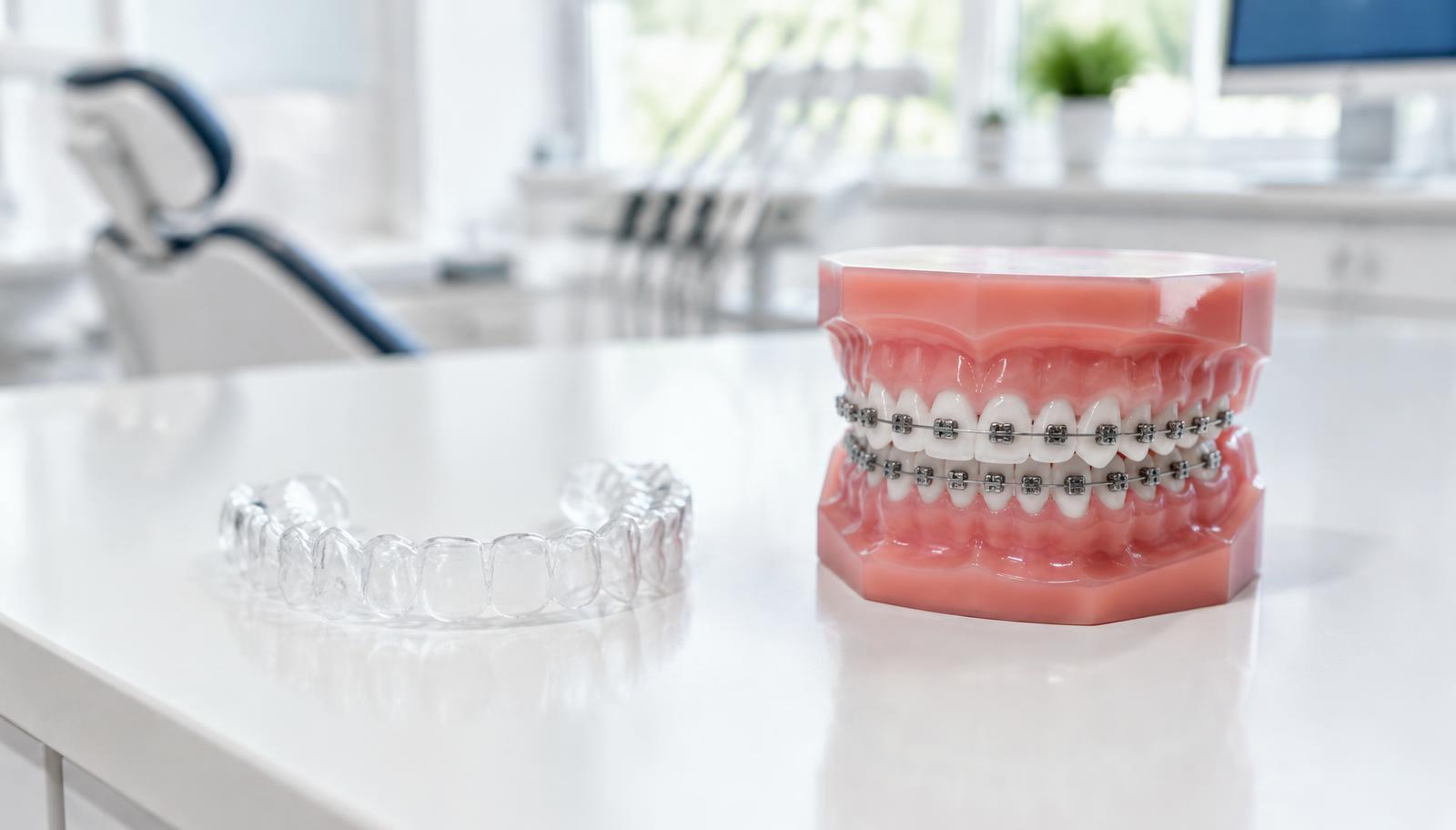
The choice between Invisalign and braces is decided by what your teeth need to do, not by which treatment looks better. At Aroma Dental in Humble, TX, Invisalign is used for crowding, overlapping and spacing, while braces are recommended for bite problems and for cases that need precise, controlled movement.
What Really Decides Invisalign vs Braces
- Your case decides, not your preference. Some movements need brackets and a wire
- Braces cover bite problems. Overbite, underbite and crossbite sit on that side of the line
- Aligners suit crowding and spacing, and they are removable, which cuts both ways
- Both are measured in months, not weeks, and how consistently you wear an aligner moves the number
- Nobody can tell you which one online. It takes records, imaging and a look at your bite
Most people arrive at this decision already leaning one way, usually toward the option that shows less. That instinct is reasonable, but it is not what the assessment turns on.
The real question in invisalign vs braces is which appliance can produce the movement your teeth need. This guide sets out how that gets decided for patients in Humble and Atascocita, and what each route asks of you along the way.
Invisalign vs Braces: What Is Each One, Exactly?
They work on the same principle and deliver it differently.
Braces are brackets bonded to the teeth and connected by a wire. The wire applies steady pressure, and the appliance is adjusted at periodic visits across the treatment period. Nothing comes off between visits, so the force is continuous whether you think about it or not.
Invisalign is a series of custom clear aligners, provided in stages. Each one moves the teeth a small amount, and you change to the next in the sequence. They come out to eat and to brush.
The American Dental Association describes orthodontic treatment as a way to correct a bad bite, and notes that removable aligners are another option for treating orthodontic problems under the direct supervision of a dentist or orthodontist. Both are orthodontics. One is fixed to your teeth and one is not.
Which Problems Is Each One Recommended For?
This is the part that settles most cases, and it is worth being specific rather than diplomatic.
Aroma Dental recommends traditional braces for:
- Moderate to severe crowding or spacing
- Bite issues such as overbite, underbite or crossbite
- Alignment problems that require precise, controlled movement
Invisalign is used for:
- Adults who want discreet orthodontic treatment
- Teens looking for an alternative to traditional braces
- Crowded or overlapping teeth
- Gaps or spacing between teeth
Read those two lists side by side and the pattern is clear. Where the problem is how the teeth sit next to each other, aligners are in the conversation. Where the problem is how the upper and lower jaws meet, braces are what get recommended. Both pages go further: traditional braces in Humble and Invisalign.
How Do Invisalign vs Braces Compare on Time, Visibility and Effort?
Three practical differences, and the third is the one patients underestimate.
Time
Invisalign treatment at Aroma Dental typically runs 6 to 24 months, varying with how complex the case is. The ADA notes that most people are in braces treatment for one to three years.
Those ranges overlap heavily. Neither appliance is fast, and the honest answer is that your case length depends on how far the teeth have to travel.
Visibility
Aligners are clear and removable, which is the whole reason most adults ask about them. Braces are visible for the duration.
Worth knowing before you plan around it: Aroma Dental provides metal braces only, so if being discreet is the priority, the route here is aligners rather than a less visible bracket.
Effort
Braces work continuously because you cannot take them out. Aligners depend on you.
Consistent daily wear is a requirement, not a suggestion, and patient compliance directly affects treatment length. If you already know you would leave them on the bathroom shelf, that is genuinely useful information to bring to the consultation.
Where Do Clear Aligners Fit?
Framing this as invisalign vs braces hides a third option, and the terminology confuses people.
Aroma Dental provides dentist-led clear aligner treatment for mild to moderate crowding or spacing, for patients wanting a removable and discreet option, and for orthodontic relapse where teeth have drifted after previous treatment.
The published limitations are the useful part:
- Consistent daily wear is required
- Not suitable for complex orthodontic cases
- Attachments may be needed
- Temporary discomfort during adjustments
That second point is the boundary. Where a case is complex, the appliance changes. The details are on the clear aligners page.
What Changes for Teens, Adults and Complex Cases?
Age changes the conversation more than most comparisons admit.
The ADA notes that orthodontic treatment often begins between ages 8 and 14, and that treatment which begins while a child is growing helps produce optimal results. At Aroma Dental, braces planning takes growth stage into account alongside alignment goals and bite correction.
For teens specifically, Invisalign is offered as an alternative to traditional braces. Whether it is the right one comes back to the same question about what the teeth need to do.
On who provides the treatment: Invisalign at Aroma Dental is delivered by Dr. Caroline Girgius, an Invisalign-certified dentist with advanced Invisalign experience, with orthodontist involvement when required. The ADA explains that orthodontic treatment may be provided by your dentist or an orthodontist, depending on the dentist's orthodontic experience and the severity of the case.
What Does the Assessment Look At?
You cannot resolve this from a comparison table, including this one.
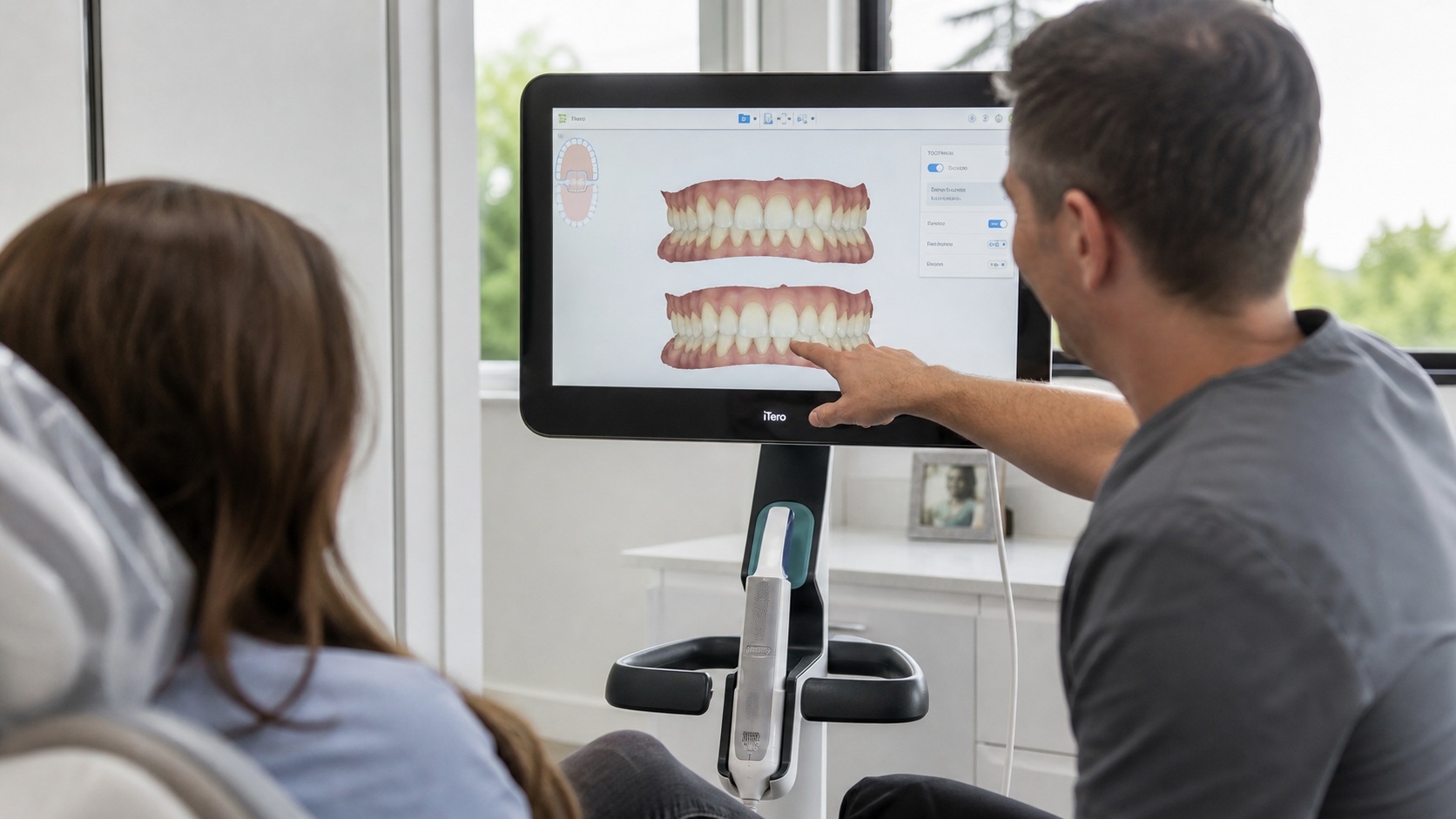
For braces, planning starts with an orthodontic assessment and standard records: photos, impressions and X-rays. Digital impressions are used for treatment planning, and imaging is used to assess jaw position and tooth movement.
For Invisalign, it starts with an initial consultation and a digital assessment, then aligners are provided in stages with regular follow-up visits to monitor progress. Cases are monitored with in-person visits.
What both processes are really establishing is the same thing: which movements your case needs, and which appliance can deliver them predictably. That is why invisalign vs braces is answered from records rather than from a preference stated at the front desk.
Which Three Questions Decide It in Practice?
Most of the braces vs invisalign decision comes down to three narrower questions, and each one has a fuller answer of its own.
How long will it take? The ranges overlap, so the useful comparison is not average against average but what drives the number in your case: how far the teeth have to move, and how consistently the appliance is worn. That is set out in how long each route takes.
Is my child old enough, or too young? Parents often meet this decision through a child rather than for themselves. Growth stage is one of the things braces planning takes into account here, and the timing question is covered in what age a child should get braces.
Will an aligner correct my bite? This is the question that most often decides the appliance, because bite correction is listed on the braces side here. Whether an aligner suits a particular bite is decided at the consultation, which is the subject of whether an aligner can correct a bite.
Answer those three honestly and the recommendation usually becomes obvious before anyone says it out loud.
What Happens After Either Treatment Ends?
Neither treatment ends when the appliance comes off, and this is the part patients are least prepared for.
Teeth do not simply stay where they were moved to. The ADA notes that braces treatment is followed by a period of wearing a retainer that holds teeth in their new positions, and the same principle applies after aligner treatment. Orthodontic relapse, where teeth drift back after previous treatment, is one of the specific situations Aroma Dental treats with clear aligners.
Treated as part of the decision rather than an afterthought, retention changes how you weigh the two. Ask at the consultation what the retention phase looks like for your case, because it is part of the commitment either way.
What Do Patients Ask When Choosing Between Braces and Invisalign?
Which Route Does Your Case Actually Call For?
If you have been going back and forth on invisalign vs braces, the deciding information is in your records, not in a comparison.
- Invisalign delivered by an Invisalign-certified dentist, with orthodontist involvement when a case requires it
- Braces planned from standard orthodontic records and digital impressions, with imaging used to assess jaw position and tooth movement
- Braces, Invisalign and dentist-led clear aligners all available in one practice in Humble, so the recommendation is not limited by what is on offer
Call our clinic to book an orthodontic assessment, or visit 7058 Farm to Market 1960 Rd E, Humble, TX 77346.