
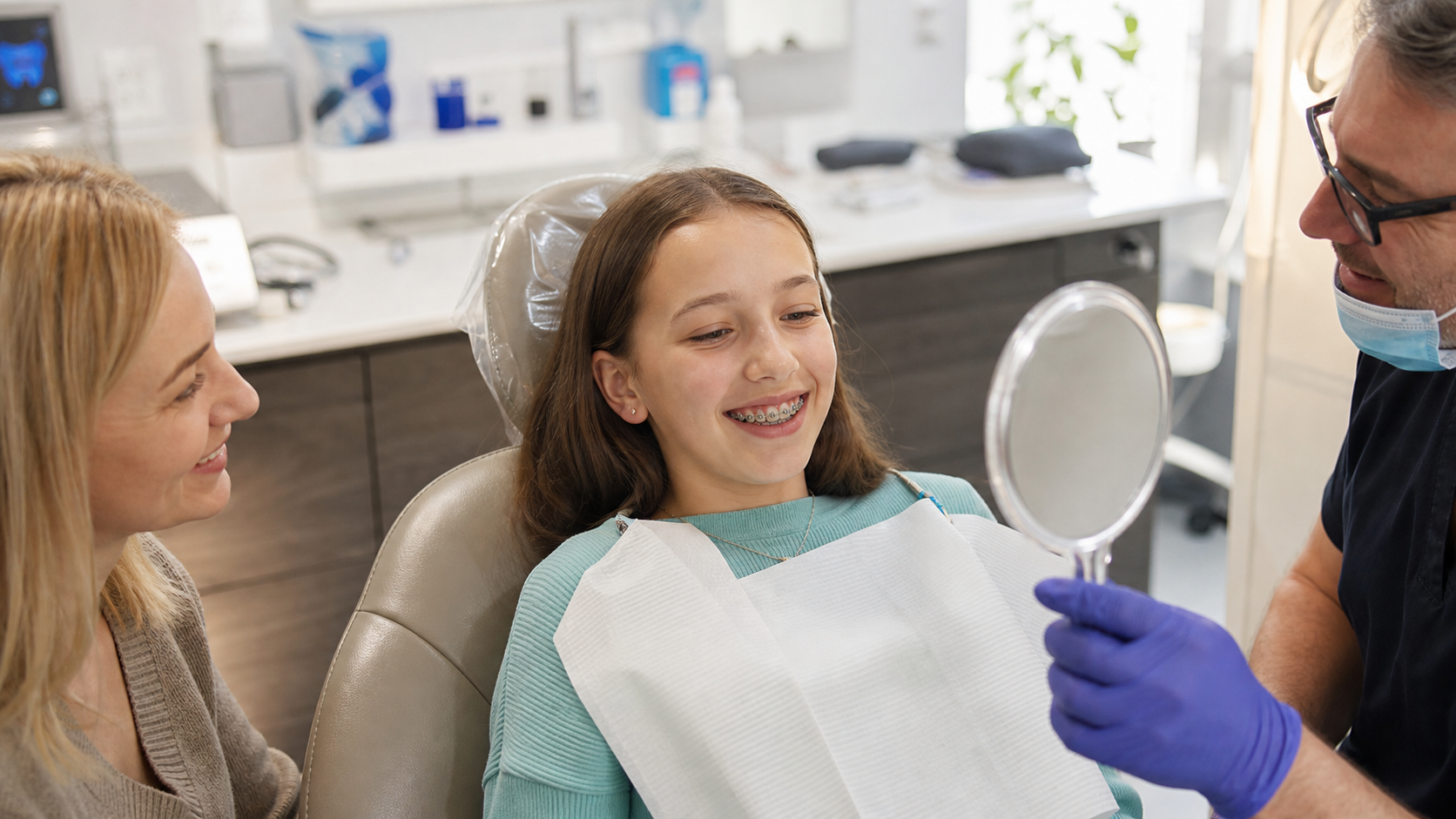
There is no single right birthday. The American Dental Association notes that orthodontic treatment often begins between ages 8 and 14, while a child is still growing. At Aroma Dental in Humble, TX, the timing for braces is set by an orthodontic assessment that looks at growth stage, the bite and the treatment goals.
Timing Braces Around Your Child, Not a Birthday
- Ages 8 to 14 is a common window, according to the ADA, not a deadline
- Growth stage matters, and braces planning here takes it into account
- The bite is the main signal. Overbite, underbite, crossbite and crowding are what get assessed
- Aroma Dental provides metal braces, planned from photos, impressions and X-rays
- An assessment answers the question that an age chart cannot
Parents usually start asking about braces when something catches their eye: a front tooth coming in crooked, a gap that is not closing, or a bite that looks off in school photos. The next thought is almost always whether it is too early, or already too late.
So, what age should a child get braces? This guide explains how timing for kids braces is actually decided for families in Humble and Atascocita, what an assessment looks at, and what treatment with metal braces involves for a child or teen.
What Age Should a Child Get Braces, and Why Is There No Single Number?
Because teeth and jaws do not develop on a fixed schedule. Two children in the same class can be years apart in how many permanent teeth they have and how their jaws are growing.
The American Dental Association says orthodontic treatment often begins between ages 8 and 14, and that treatment which begins while a child is growing helps produce optimal results. That is a range, not a rule, and it is the reason the question gets answered child by child.
At Aroma Dental, the recommendation for braces is based on an orthodontic assessment, growth stage and treatment goals. In practice, that means the right age is the age at which your child's own teeth and jaws make treatment worthwhile.
Which Signs Suggest Your Child Should Be Assessed?
You do not need to diagnose anything yourself. These are simply the things worth mentioning at your child's next dental visit.
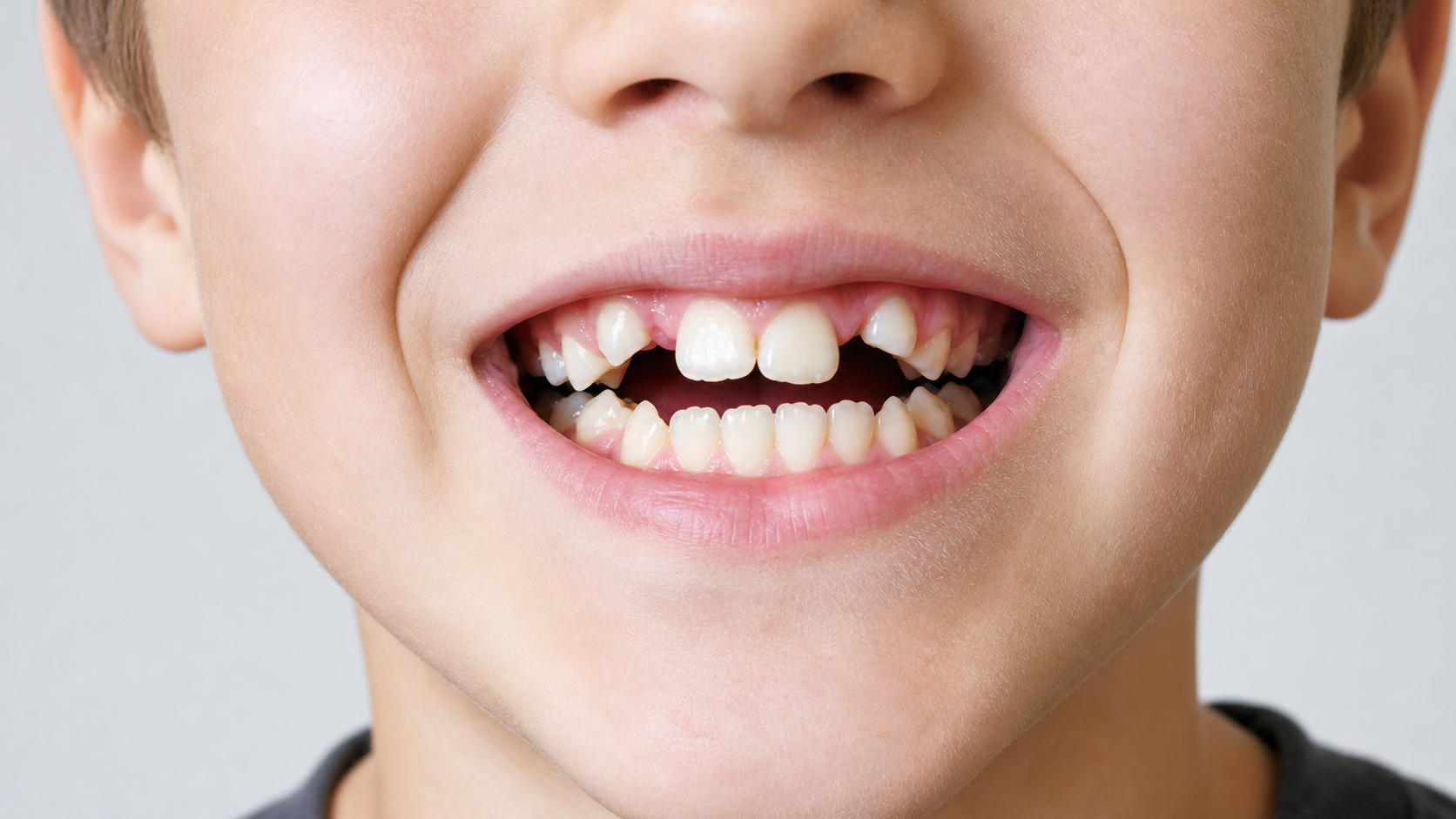
- Crowded or overlapping teeth, especially as permanent front teeth come in
- Gaps or spacing that do not seem to be closing
- An overbite, where the upper front teeth sit far over the lower ones
- An underbite or crossbite, where some lower teeth sit in front of or outside the upper ones
- Teeth that meet unevenly when your child bites down
The ADA explains that bite problems may be inherited, or may result from injury, early or late tooth loss, or thumb sucking. None of those are anyone's fault, and all of them are things the dentist will ask about.
Aroma Dental most commonly recommends traditional braces for moderate to severe crowding or spacing, for bite issues such as overbite, underbite or crossbite, and for alignment problems that require precise, controlled movement. More detail is on the traditional braces in Humble page.
Why Does Growth Stage Matter So Much?
A growing child is not a small adult, and that changes how a bite is planned.
When jaws are still developing, the relationship between the upper and lower arches is still changing. That is why the ADA links treatment during growth with better results, and why braces planning at Aroma Dental is customized around alignment goals, bite correction and growth considerations.
It also explains why the answer can be "not yet." Some children are assessed, found to have a bite worth watching, and simply monitored at regular visits until the timing is right. Regular recall visits and early detection are part of how children's care is approached here.
How Are Kids Braces Planned at Aroma Dental?
Planning follows the same careful steps for a child as for an adult, with growth added to the picture.
- An initial orthodontic assessment, to see what the teeth and bite need
- Standard orthodontic records: photos, impressions and X-rays
- Digital impressions for treatment planning, and imaging to assess jaw position and tooth movement
- A treatment plan customized to alignment goals, bite correction and growth
- Bracket placement, followed by periodic adjustment visits over the treatment period
Technology is selected based on the patient's age, the complexity of the case and how closely it needs to be monitored, so a younger child's records may not look identical to a teenager's.
Treatment duration varies based on how far the teeth need to move and on patient compliance. The ADA notes that most people are in treatment from one to three years.
Why Metal Braces for Children and Teens?
Aroma Dental provides metal braces only. For a family weighing options, that is useful to know before the first visit rather than after.
Metal brackets are bonded to the teeth and connected by a wire, and the wire is adjusted at periodic visits to move the teeth in a controlled way. Because they are fixed, they work whether or not a child remembers to put anything in, which is a real advantage for younger patients.
For teenagers who want something less visible, Invisalign is offered at Aroma Dental for teens looking for an alternative to traditional braces, mainly for crowded, overlapping or spaced teeth. Whether a teen's case suits aligners is decided at the assessment. The full comparison is in how the choice between Invisalign and braces gets made.
What Is It Like for a Child to Have Braces?
Most of the adjustment is about routine, not discomfort, and children usually settle into it faster than parents expect.
Comfort at visits. The pediatric approach at Aroma Dental uses gentle, child-friendly communication, a tell-show-do approach and parental involvement during visits. Children see and hear what is going to happen before it happens.
Cleaning around brackets. Food collects around brackets, so brushing becomes more important, not less. Oral hygiene education for children and parents is part of children's care here, along with guidance on diet and habits.
Extra protection. Fluoride treatment is recommended at Aroma Dental for patients with orthodontic appliances and for children and teens at higher cavity risk, which often describes a child in braces.
Keeping up with checkups. Adjustment visits do not replace routine dental care. The practice's pediatric dentistry covers exams, cleanings and cavity prevention throughout treatment.
What If More Than One Child Needs Treatment?
It happens often, since bite patterns can run in families.
Aroma Dental treats children, teens, adults and seniors, and multiple family members can be treated under one clinic. Care is coordinated across family members, with individual treatment plans for each person and flexible scheduling for families. A sibling's assessment can often be planned alongside another child's visit. See family dentist for how that works.
On cost, there are no prices in this article. Insurance may cover a portion of orthodontic treatment depending on plan limits, payment plans or financing options are offered for orthodontic care, and treatments are explained clearly before anything proceeds.
Is It Ever Too Late for Braces?
No. Teens and adults are treated too.
The ADA notes that healthy teeth can be orthodontically treated at any age, and the same assessment process applies whatever your child's age. What changes after growth has finished is the plan, not whether treatment is possible. For parents, the practical takeaway is that missing the 8 to 14 window does not close the door.
What Do Parents Ask About Braces for Kids?
Wondering Whether Now Is the Right Time for Your Child?
If you have noticed crowding, gaps or a bite that looks off, an assessment will tell you whether to start, wait or simply keep watching.
- Braces recommendations based on an orthodontic assessment, growth stage and treatment goals
- Records that include photos, impressions and X-rays, with imaging to assess jaw position
- A gentle, child-friendly approach with parents involved in visits
Call our clinic to book an orthodontic assessment for your child, or visit 7058 Farm to Market 1960 Rd E, Humble, TX 77346.