
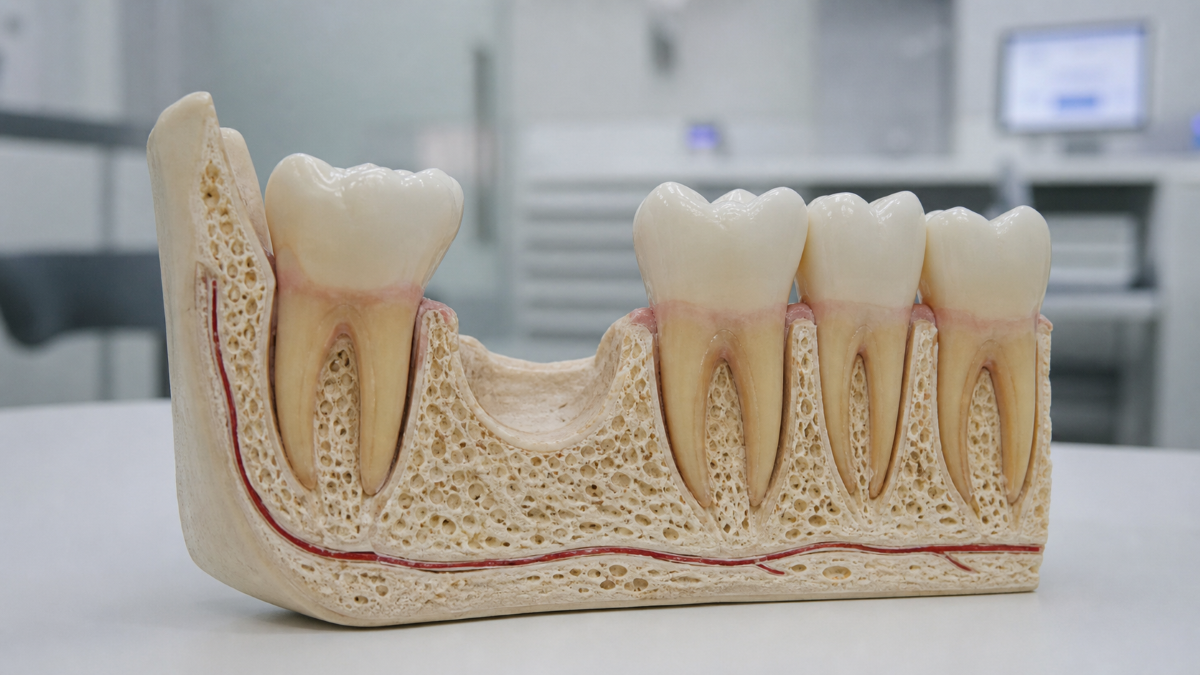
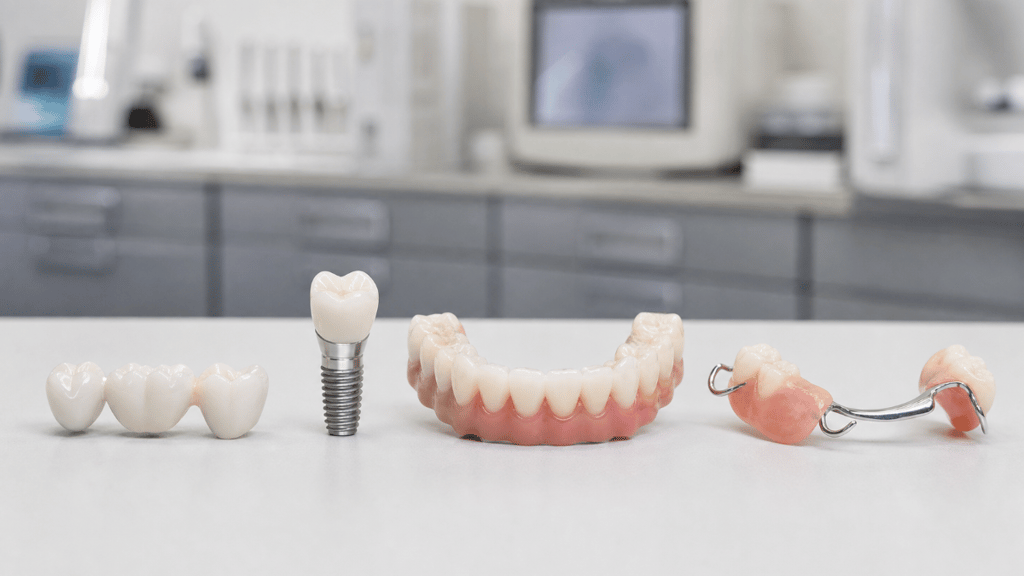
Patients in Humble, TX have four main options for missing teeth: a dental bridge, a removable denture, a denture stabilized by implants, or dental implants placed individually or across a full arch. The right choice depends on how many teeth are gone, how much jawbone remains, and whether you want something fixed or removable.
The Short Version, Before You Read Further
- Doing nothing is also a choice, and it changes your mouth over time rather than leaving it as it is
- Bone is the deciding factor more often than cost. It determines which options stay open to you
- Fixed or removable is the first real fork in the road, not the brand of treatment
- One missing tooth and a full arch are different problems with different answers
- Every option has a lifespan. None of them is a one-time purchase
- The assessment comes first. Nobody can tell you what suits your mouth without imaging
Losing a tooth is common, and for a while nothing much seems to happen. That is the part that catches people out.
The changes that follow tooth loss are slow and mostly invisible, which is why patients across Humble and Atascocita find the conversation about options for missing teeth easier to have early than late. This guide sets out what actually happens, what the choices are, and how they differ.
What Happens After You Lose a Tooth
A tooth is not just the part you can see. Below the gumline the root sits in bone, and that bone exists because the root gives it a job: absorbing the load every time you bite.
Remove the root and the job disappears. The bone that held it begins to thin, gradually, over months and years. This is the single most important thing to understand about tooth loss, because bone is what every replacement option eventually depends on.
Three other things happen alongside it:
- Neighboring teeth drift. Teeth are held in position partly by the teeth beside them. Open a gap and the neighbors slowly tip or slide toward it.
- The opposing tooth over-erupts. The tooth above or below the gap has nothing to meet, so it drifts down or up out of line.
- Bite forces redistribute. The work that tooth was doing is now shared by the others, which accelerates wear on them.
The American Dental Association notes that bone actually grows around a dental implant and holds it in place, which is the same biological relationship a natural root has. That relationship is what tooth loss interrupts.
What Are the Options for Missing Teeth?
Four, and they divide first by whether the result comes out of your mouth.
Fixed: a dental bridge
A bridge fills the gap using the teeth on either side as support. It does not involve surgery, and it does not go into bone.
The condition is that those neighboring teeth have to be sound enough to carry it. Traditional, cantilever and Maryland designs exist for different situations, and the Maryland version is the most conservative because the adjacent teeth are largely left alone. See dental crowns and bridges.
Fixed: dental implants
An implant is a titanium post placed into the jawbone, which then integrates with it and functions as a root. A restoration is fitted on top.
This is the only option that replaces the root rather than just the visible tooth, and it is the reason implants are the option most dependent on available bone. One gap or several can be treated this way. See dental implants.
Fixed: a full arch on four implants
Where most or all of an arch is gone, four implants placed at deliberate angles can carry a complete fixed set of teeth. Nothing is removed for cleaning.
This is a surgical treatment with a healing phase measured in months, and it is not suitable for every patient. See all-on-4 implants.
Removable: dentures, with or without implants
A conventional denture rests on the gum and comes out. It restores chewing, speech and facial support, and it is the option with the fewest requirements.
A snap-on denture sits between the two categories: implants are placed, and the denture clips onto them. It still comes out for cleaning, but it does not move while you eat.
Because those implants load the bone, they help preserve jawbone density in a way a conventional denture cannot. See dentures and snap-on dentures.
Comparing Options for Missing Teeth Side by Side
| Bridge | Implant | Full arch on four | Denture | Snap-on denture | |
|---|---|---|---|---|---|
| Comes out | No | No | No | Yes | Yes |
| Needs surgery | No | Yes | Yes | No | Yes |
| Depends on bone | No | Yes | Yes | Less | Yes |
| Involves neighbors | Yes | No | n/a | No | No |
| Expected life | 7 to 15 years | 10 to 15 years, often longer | Implants 20 years, teeth 10 to 15 | 5 to 10 years | Implants long-term, inserts replaced periodically |
Two things stand out when you set them next to each other.
The first is that replacing missing teeth without surgery is entirely possible. Bridges and dentures both do it. What they cannot do is stop the bone underneath from changing, which is why a denture that fit well five years ago may not fit well now.
The second is that no option is permanent in the sense people mean. Every row in that table has a number in it.
How Many Teeth Are Missing Changes the Answer
This is where most online advice goes wrong. It treats a single gap and a bare arch as the same question.
One tooth. The realistic choice is a bridge or an implant. The trade is that a bridge is quicker and involves the neighboring teeth, while an implant leaves them untouched but needs bone and time.
Several teeth. Partial dentures, multiple implants, and implant-supported bridges all come into play. Where the gaps sit matters as much as how many there are.
Most or all of an arch. Now it is a conventional denture, a snap-on denture, or a fixed full arch. The options to replace missing teeth narrow to these three, and the decision usually turns on cleaning and stability rather than appearance.
Why Bone Decides More Than You Expect
An implant needs enough bone to anchor in. That is a measurement, not an opinion, and it is taken from imaging rather than from looking in your mouth.
Two consequences follow. The first is that the longer a gap has been there, the more likely bone height has reduced. The second is that where bone is inadequate, it can often be added: bone grafting rebuilds the site so an implant becomes possible.
In the upper back jaw the sinus sits directly above the molars, and the bone between them is thin to begin with. Where it is too thin, a sinus lift adds height beneath the lifted sinus membrane before an implant is placed.
There is a fuller account of all of this in why the jaw shrinks after tooth loss.
None of this rules anything out on its own. It changes the sequence and the timeline.
Fixed or Removable: The Question Worth Answering First
Most people arrive assuming fixed is simply better. It is not that straightforward.
Fixed teeth do not move, need no adhesive, and are not taken out. They also have to be cleaned in place, which needs a degree of manual dexterity, and reaching under a fixed full arch is genuinely harder than brushing a denture at the sink.
Removable options come out, which some patients dislike and others prefer for exactly that reason. A snap-on denture is often the sensible middle: the stability of implants with the cleaning access of something removable.
Working through this honestly is more useful than comparing brand names. There is a fuller treatment in implants compared with dentures, and if surgery is not on the table at all, alternatives to implants covers what remains.
What the First Appointment Actually Involves
Whichever direction you are leaning, the sequence at Aroma Dental is the same. Suitability is assessed through clinical examination and imaging, and the practice provides a comparison between implants, dentures and bridges rather than a single recommendation.
That order matters. The imaging tells you what is available; the comparison tells you what each route asks of you. Cost is discussed at the practice once the plan is known, because it depends entirely on which option and how many teeth.
Patients across Humble, Atascocita and the 77346 area are seen for this assessment, and it is worth booking sooner rather than later for one reason only: the bone question gets harder to answer the longer a gap is left.
FAQs About Replacing Missing Teeth
Find Out Which Options Are Actually Open to You
If you have been putting off a decision because you do not know where to start, the useful first step is not choosing a treatment. It is finding out what your bone allows.
- Suitability assessed through clinical examination and imaging, so the answer is a measurement rather than a guess
- A comparison between implants, dentures and bridges provided, not a single option presented as the only one
- One practice for the assessment, the treatment and the follow-up, in Humble on FM 1960 between Humble and Atascocita
Call Aroma Dental to book an assessment, or visit 7058 Farm to Market 1960 Rd E, Humble, TX 77346.