
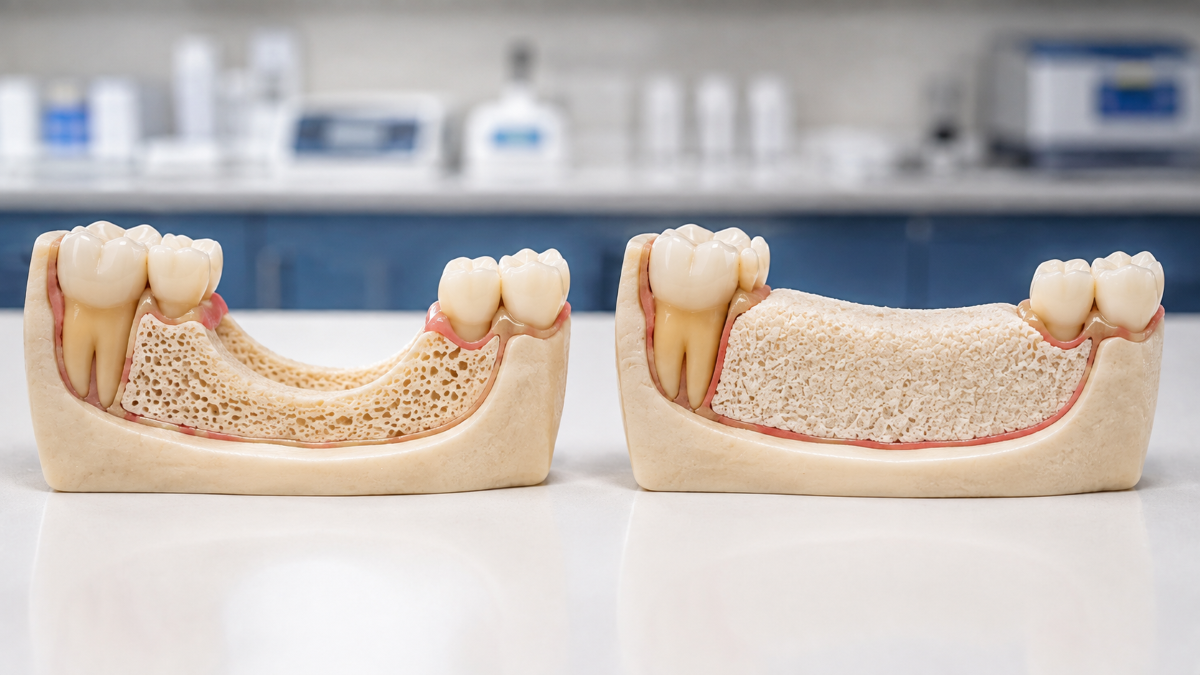
A dental bone graft rebuilds the jawbone that has thinned, usually so a dental implant has enough depth to anchor in. At Aroma Dental in Humble, TX, the site is planned from CBCT imaging and the graft is placed using natural, synthetic or combination material. A healing period follows before any implant goes in.
What This Comes Down To
- Bone disappears when a root does. The jaw thins at the site of a missing tooth, month by month
- A graft rebuilds the site rather than treating a disease. It is preparatory work
- Imaging decides, not appearance. Bone height is a measurement taken from a CBCT scan
- Bone loss rarely rules out implants. More often it changes the sequence and adds months
- Success is measured, not judged. Bone stability and volume on a follow-up scan is the test
- Where the upper molars sit, the sinus is the constraint, which is a specific kind of graft
If someone has told you that you need a graft before an implant, it usually means one thing: the bone at that site has thinned since the tooth came out. That is normal, it is not a complication, and patients across Humble and Atascocita hear it regularly.
This article answers what is a dental bone graft in practical terms, and what the procedure asks of you.
What Is a Dental Bone Graft?
It is a procedure that adds bone material to a site where the jaw has lost volume, so that the site can support something later.
That "something later" is almost always an implant. An implant is a titanium post placed into the jaw, and it needs a certain depth and width of bone to hold. Where the bone is short of that, grafting builds it back up first.
The material itself comes in three categories, and Aroma Dental uses all three depending on the case: natural, synthetic, or a combination of the two. Which one suits a given site is decided at planning.
It helps to be clear about what this is not. A graft does not treat gum disease, it does not fix a tooth, and it is not cosmetic. It is groundwork.
Why the Jaw Loses Bone in the First Place
The bone around a tooth root exists because the root uses it. Every bite transmits load through the root into the surrounding bone, and bone responds to load by maintaining itself.
Take the root away and that stimulus stops. The bone at the site begins to reduce in height and width, gradually, over months and years. It is the same principle that makes a limb lose muscle in a cast.
This is why the answer to "how long have you had the gap?" matters so much at an implant consultation. The American Dental Association describes how bone grows around an implant and holds it in place, and that same relationship is what stops working when a root is lost.
Two things follow from this:
- Time works against you, slowly. A gap left for a decade has usually lost more height than one left for a year.
- A denture does not stop it. A conventional denture rests on the gum rather than loading the bone, which is why fit changes over the years. See dentures.
When Is a Dental Bone Graft Needed, and What Is a Dental Bone Graft For?
Not every implant needs one. The graft comes into the plan when imaging shows the available bone is short of what the implant requires.
Three situations account for most cases:
- A long-standing gap, where the site has had years to thin.
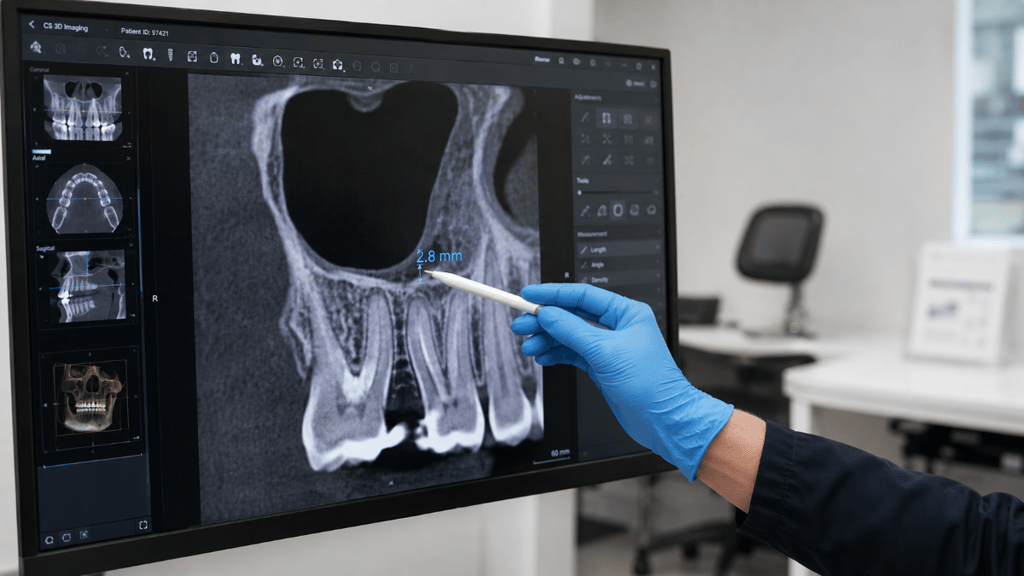
- The upper back jaw, where the maxillary sinus sits directly above the molars and the bone between them is naturally thin. Losing an upper molar leaves very little.
- Bone lost alongside the tooth, where whatever removed the tooth also affected the bone around it.
The second of these has its own procedure. Where the constraint is the sinus rather than the ridge, the membrane is lifted and graft material is placed beneath it, which is a sinus lift.
How Does a Bone Graft Work?
The principle is that grafted material acts as a scaffold. Your own bone grows into and replaces it over time, which is why the healing period is not optional.
At Aroma Dental the sequence for a sinus-related graft is set out clearly:
- CBCT imaging to plan the site precisely, because bone height in the upper back jaw cannot be judged from a standard X-ray
- Accessing the area through the upper jawbone
- Lifting the sinus membrane carefully, using precision surgical instruments made for that purpose
- Placing the graft material beneath it
- Waiting, because the graft has to knit into the bone that is already there
Sterile and biocompatible materials are used throughout. The ability to take and process three dimensional imaging allows us to plan implant placement using accurate measurements for the best results.
What Happens While It Heals
A healing period is required before an implant can be placed. That is the structural fact about grafting and the reason it adds months to an implant timeline rather than weeks.
During that period two things happen at the practice:
- You are seen again, and how well the bone has taken is checked with imaging rather than guessed at
- Success is evaluated on bone stability and volume, which are measurable rather than a matter of opinion
That second point is worth valuing. Whether the graft worked is not a judgment call at a review appointment. It is a reading taken from a scan, and the implant proceeds on the strength of it.
Aroma Dental's position on duration is that timelines vary depending on individual healing response, so no fixed number is published here.
Can You Get Dental Implants With Bone Loss?
Usually yes. This is the most common worry and the most commonly misunderstood answer.
Bone loss is not a disqualification. A treatment plan will change depending on the amount of bone present. More bone may be added to allow an implant to be placed with a higher likelihood of success and longevity.
Sufficient jawbone support is a requirement for implants, and suitability is assessed through clinical examination and imaging. See dental implants.
If grafting is not something you want to take on, that is a legitimate position, and there are routes that avoid it entirely. Bridges and removable options do not go into bone at all.
Alternatives to implants sets those out, and the wider picture is in options for missing teeth.
Questions Patients Ask About Bone Grafting
Find Out Whether You Need a Graft Before You Decide Anything Else
If bone loss is the thing standing between you and an implant, the useful next step is a scan rather than a decision. It tells you whether grafting is needed at all, and if so how much.
- CBCT imaging used to measure bone height precisely, rather than estimate it from a standard X-ray
- Nothing moves to the implant stage until the healed site measures up on stability and volume, so the order of treatment is driven by readings, not by the calendar
- Natural, synthetic and combination graft materials all available, chosen per site
Call Aroma Dental to arrange an assessment, or visit 7058 Farm to Market 1960 Rd E, Humble, TX 77346.